
If you or someone you love has been recently diagnosed with coeliac disease, you could be eligible to receive gluten free foods on prescription. Simply select your country of residence, and, if you live in England, fill in your postcode to check if your area is prescribing.
Your country is prescribing gluten free foods*. Request your Glutafin Taster Box by clicking the button below to sign up.
* Please note: local policies are constantly updated, and issuing a prescription is at the discretion of your GP.


Coeliac Disease (pronounced see-lee-ack) is a lifelong autoimmune condition, triggered by an intolerance to gluten, a protein found in wheat, rye and barley. In a person with coeliac disease, the immune system mistakes gluten in the gut as a ‘foreign body’ and reacts by causing damage to the delicate lining of the small intestine (small bowel).
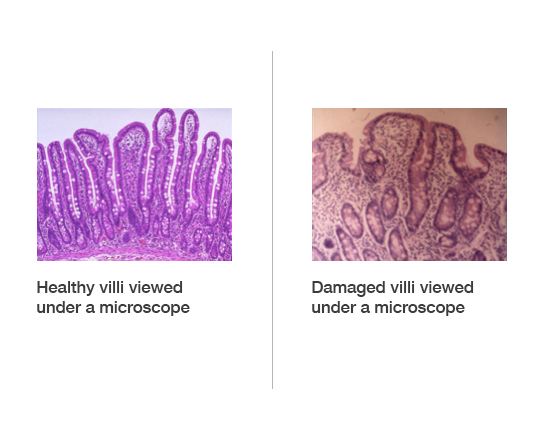
The lining of your small bowel contains thousands of microscopic finger-like projections called ‘villi’. Villi are essential for the absorption of nutrients from food.
For someone with coeliac disease, eating food that contains gluten causes damage to the lining of the small bowel and ‘flattening’ of the villi. This means the villi aren’t able to work as effectively and, as a result, your body is less able to absorb important nutrients from food.
Coeliac Disease affects around 1 in 100 people, but with only 36% diagnosed in the UK, there are around 400,000 people who have not yet been diagnosed.
Coeliac Disease was once considered a childhood disease but diagnosis can occur at any age and coeliac disease is now most often diagnosed in people who are between forty and sixty. Some people may be more at risk of developing coeliac disease, for example, close relatives of people with the condition or those with other autoimmune conditions such as type 1 diabetes or autoimmune thyroid disease.
Gluten is a protein found in wheat, rye and barley. The main function of gluten is to act as a binding agent, which gives baked goods their characteristic structure and texture. Gluten is found in many foods, for example:
Gluten is also present in many foods you might not expect, for example:

It’s always best to check food labels. For more information on which foods do and don’t contain gluten, along with foods to check, visit our food allergen section in living gluten free.
Some people with coeliac disease may also not be able to tolerate ingredients such as gluten free wheat starch or oats, we advise that you ask your gastroenterologist or dietitian if you can include them in your diet.
Read about the symptoms of coeliac disease
If you or someone you love has been recently diagnosed with coeliac disease, you could be eligible to receive gluten free foods on prescription. Simply select your country of residence, and, if you live in England, fill in your postcode to check if your area is prescribing.
Your country is prescribing gluten free foods*. Request your Glutafin Taster Box by clicking the button below to sign up.
* Please note: local policies are constantly updated, and issuing a prescription is at the discretion of your GP.
People with coeliac disease have specific genes, which means they may develop the condition when they eat gluten. However, coeliac disease can develop at any age and researchers are unsure why this is the case.
If you are experiencing symptoms and suspect you may have coeliac disease, the first step could be to take an online assessment- a short questionnaire asking about your symptoms and other risk factors. If the assessment indicates that you might have coeliac disease, the next step would be to make an appointment with your GP who can then undertake a blood test to check for coeliac antibodies.
If the result of your blood test is positive, your GP should refer you to the hospital for further tests in order to confirm a diagnosis of coeliac disease. It is important not to remove gluten from your diet during the diagnosis process.